
24/7 service · Free inspection

16062
Toshiba ServiceEGYPT SERVICE CENTER
Services

Toshiba Microwave Repair — the One Appliance You Should Never Open Yourself

Microwave running but not heating? Sparks inside? Turntable stuck? Call 16062 — Toshiba microwave repair hotline, 24/7 across Egypt. Before you search for a DIY video: a microwave's high-voltage capacitor stores a charge of thousands of volts that persists long after unplugging. Leave it to a specialist with proper discharge tools — free inspection, genuine parts, and a written 6-month warranty.

We fix: solo (reheat-only) · grill · large digital — every Toshiba microwave generation.

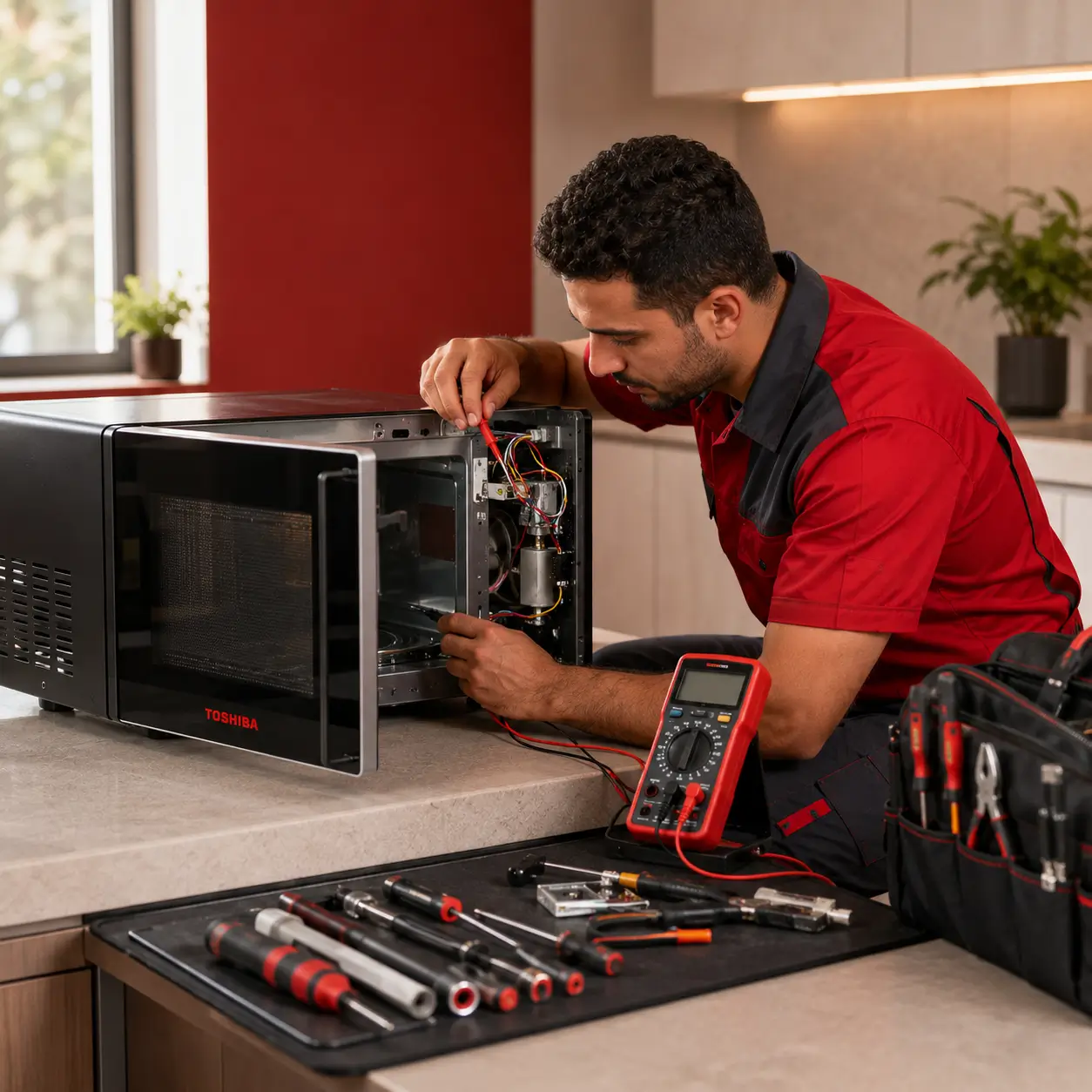
Safe in-home Toshiba microwave repairTOSHIBA

⚠️ Safety first: never open a microwave casing yourself — even days after unplugging. The high-voltage capacitor inside retains a charge of thousands of volts, and one wrong touch can be fatal. Even the internal fuse sits next to it and requires capacitor discharge first. What IS safe: unplug, clean the cavity, and try the no-tools steps under each fault below. Anything beyond that — call 16062.

Common Toshiba Microwave Faults: Symptoms, Causes, What to Try

Our standard method: causes ordered from most to least common, one safe step to try yourself — with no tools — and when a technician becomes necessary. For microwaves, "safe" literally means: from outside the appliance only.

Runs but does not heat — light, turntable and timer all fine, food stays cold

The most common fault of all.

Causes

worn-out magnetron (the microwave generator itself), failed high-voltage diode, weak capacitor, blown HV fuse, or one of the three door interlock switches cutting only the heating circuit. Safe test: the water-cup test — heat a cup of water (never run it empty) for one minute on full power; if the water stays cold, the high-voltage circuit is confirmed faulty. That is exactly the circuit you must not open — call 16062; magnetrons and diodes are stocked, so it is usually a one-visit repair.
Sparks or arcing inside the cavity

Causes

the mica waveguide cover saturated with food residue or punctured, metal inside the cavity (spoon, foil, gold-rimmed plates), chipped cavity paint exposing bare metal, or a damaged waveguide.

Try safely

stop immediately, remove any metal, and clean the cavity and mica sheet thoroughly after unplugging. If sparking returns with clean cookware, the mica or paint needs replacing — a cheap, quick fix, but do not keep using it: arcing progressively damages the waveguide and magnetron.

Turntable not rotating — food heats on one side only

Causes

broken or derailed roller ring under the glass plate, worn coupler, or a failed turntable motor.

Try safely

remove the plate and ring, wash them, and reseat them correctly — built-up residue jams the ring more often than you would think. If it still will not turn, the motor is accessed from underneath, next to the HV circuit — a technician job.

Completely dead — or trips the breaker the moment the door closes

Causes

the three door interlock switches (the most commonly failed part — usually from slamming), which by design blow the main fuse instantly as protection; the fuse itself; broken door hooks; or the control board.

Try safely

check the plug, inspect the door hooks visually, try another outlet. If it trips the breaker or stays dead, fuse and switches must be replaced together — a new fuse alone will blow again on first use because the cause remains.

Buttons unresponsive or display acting up

Causes

membrane keypad worn by kitchen heat, steam and grease (very common), moisture reaching the board, or the control board itself.

Try safely

unplug for 10 minutes (a simple reset clears temporary glitches) and clean the keypad surface. If a specific button is dead, the keypad needs replacing — we stock keypads and boards for popular Toshiba models.

Unusually loud noise or a burning smell

Causes

a magnetron near end-of-life (loud buzz plus weak heating together are near-certain confirmation), cooling fan fouling, dry or cracked roller ring (clicking while rotating), or a humming capacitor/transformer.

Try safely

clean the ring and plate, make sure vents are clear and nothing sits on top. Any burning smell = unplug immediately and call — continuing turns a one-part fault into a board fault or an internal fire risk.

Why Is the Microwave the One Appliance We Say "Never Open"?

On our other guides we encourage DIY steps — cleaning filters, levelling, gasket tests. The microwave is different, and the reason is physics, not marketing: behind the casing sits a high-voltage capacitor charged to thousands of volts to drive the magnetron, and it retains that charge for days after unplugging. Most serious appliance-related electric-shock injuries at home involve people repairing an unplugged microwave they believed was safe.

  • Even the internal fuse — the simplest part — sits next to the capacitor; replacing it safely requires discharging the charge with a dedicated tool first.
  • Ordinary household-electrics experience does not transfer: mains is 220V; this capacitor operates at many times that.
  • Our technician discharges and verifies the capacitor before touching anything inside — the mandatory first step of our service protocol.
  • This is exactly why our inspection is free: we want you to call before attempting to open it, not after.

Bottom line: everything outside the appliance — cleaning, plate, ring, plug — is yours to try. Anything behind a screwdriver = call 16062.

Every Toshiba Microwave Type

  • Solo (reheat-only): the most common 20-25L home models — magnetron, diode, fuses, door switches.
  • Grill models: heating-circuit faults plus grill-element and combi-mode failures.
  • Large & digital 28-42L: board, keypad and sensor faults on modern multi-program models.
  • Older and discontinued models: certified compatible magnetrons and parts available for most Toshiba generations.

Worth Repairing, or Buy New? A Straight Answer Before You Spend

It is the first question anyone with a broken microwave asks — and our answer is not "repair it and that's that". This is the rule we apply, openly:

  • Always worth repairing: fuses, door switches, roller ring and turntable motor, mica sheets, keypads — relatively cheap parts replaced in the same visit, after which the unit runs like new.
  • The real decision comes at the magnetron or the board: after inspection we quote the exact part and labour price before any work — and the decision is yours.
  • The rule we advise our customers: if the repair cost approaches half the price of a new unit of the same size and features, our own technician will tell you plainly that repairing is not in your interest — it happens, and we say it.
  • And remember: the inspection is free — you get that honest answer at no cost and with no commitment.

Call 16062 or send the model and fault on WhatsApp 01050887010 — you will get a clear "worth it / not worth it" answer before spending anything.

How Our Microwave Service Works

  1. 1

    Call 16062 and describe the symptom — "runs but no heat" or "sparking" — or send the model and fault on WhatsApp 01050887010 for a free preliminary diagnosis.

  2. 2

    Same-day visit in most areas — the technician arrives carrying the common parts: magnetron, diode, fuses, door switches, mica sheets.

  3. 3

    Safe full inspection starting with capacitor discharge, then HV-circuit, switch and board testing — inspection is free and the final price is quoted before any work. And if a repair is not economical versus a new unit, we tell you straight — your decision, fully informed.

  4. 4

    Repair with genuine parts in front of you, a real heating test before the technician leaves, and a written 6-month warranty covering part and labour.

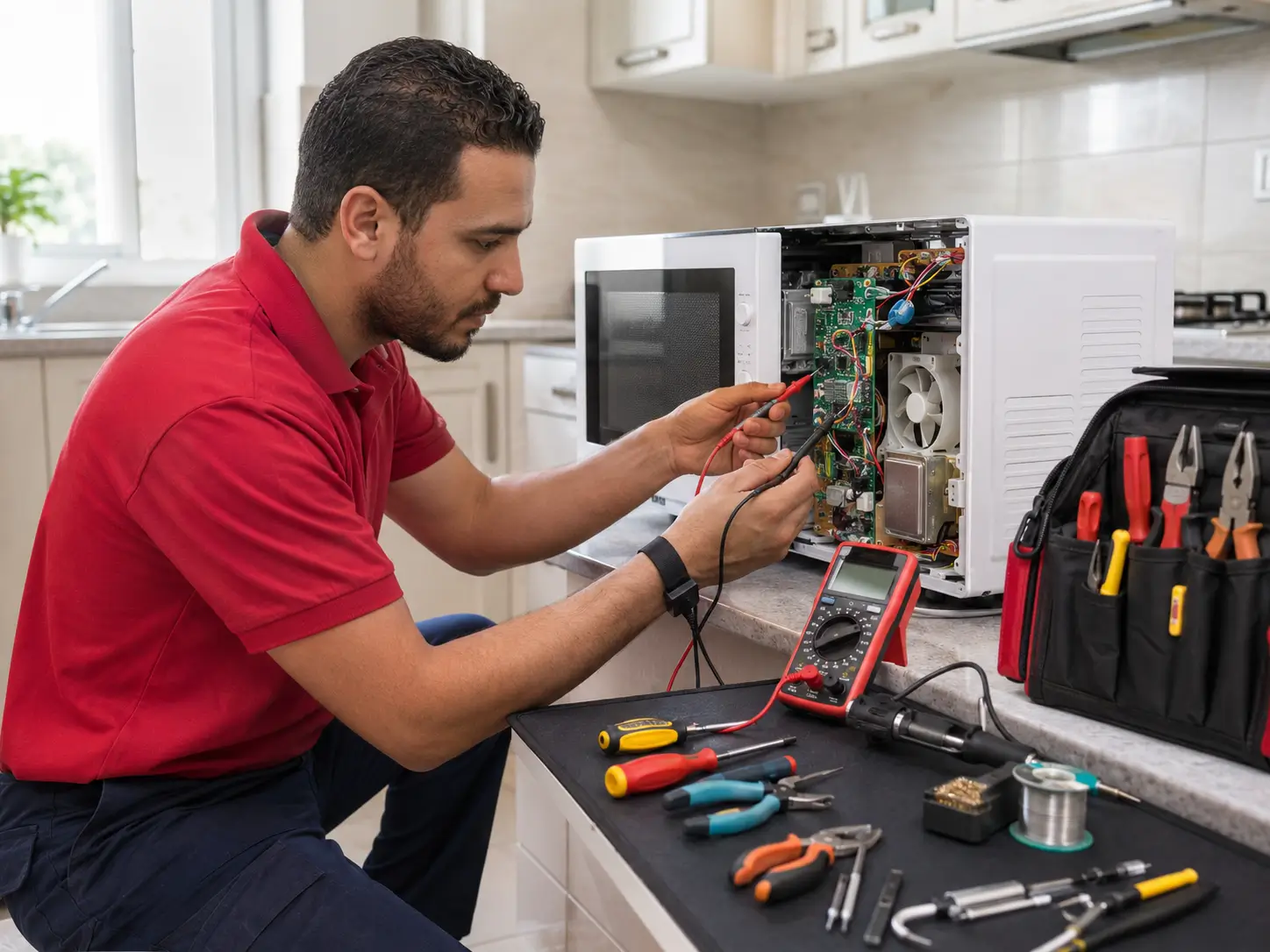
Technician inspecting a Toshiba microwave after capacitor discharge

Genuine Toshiba Microwave Parts

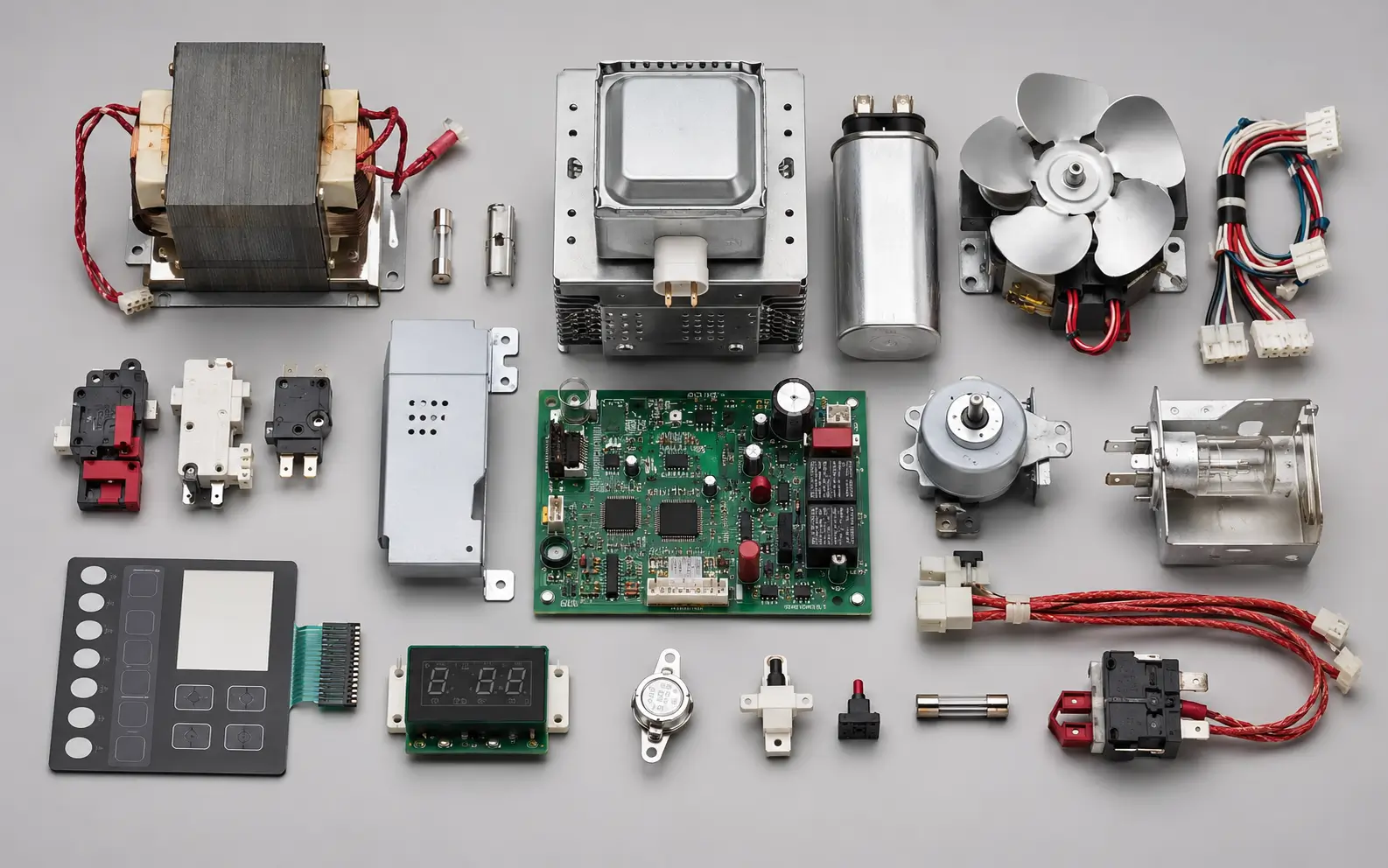
Genuine Toshiba microwave spare parts

Permanent stock of the most-requested microwave parts. Parts are fitted in front of you, old parts handed back, itemised invoice, and the 6-month warranty covers both part and repair.

MagnetronHV diode & capacitorFusesDoor interlock switchesTurntable motorMica sheetsKeypads & control boardsLamps & roller rings

5 Technicians' Tips That Extend Microwave Life

  1. 1Never run it empty — with nothing to absorb them, the waves reflect back into the magnetron and burn it out. Even for a quick test: use a cup of water.
  2. 2Clean the mica sheet and cavity walls weekly — residue baked onto the mica is the number-one cause of arcing and waveguide damage.
  3. 3No metal, ever: spoons, foil, gold- or silver-rimmed plates — one arc can cost you a whole magnetron.
  4. 4Close the door gently — door interlock switches are the most broken part in any microwave, and slamming is the top cause.
  5. 5Keep 10cm of ventilation clearance and nothing on top of the vents — trapped heat shortens magnetron and board life.

Toshiba Microwave Repair Across All of Egypt

Specialist technicians in Cairo, Giza, Alexandria and every Delta, Canal and Upper Egypt city. Call 16062 and mention your area — and if the microwave serves a business (café, restaurant or office), say so on the call for priority response.

Toshiba Microwave Repair — FAQ

What is the Toshiba microwave repair number in Egypt?

The short number 16062, 24/7 nationwide. You can also send your model and fault on WhatsApp 01050887010 for a free preliminary diagnosis before any visit.

My microwave runs but does not heat — what is wrong?

Do the water-cup test: run it for one minute on full power with a cup of water inside — if the water stays cold, the high-voltage circuit is faulty (magnetron, diode, capacitor or HV fuse). That is precisely the dangerous circuit you must not open yourself — call 16062; these parts travel with the technician and it is usually fixed in one visit.

Is repairing a microwave worth it, or should I buy new?

Honestly: it depends on the fault and model. Fuses, door switches, roller rings and mica sheets are cheap and always worth it. A magnetron is worth it on larger and recent models; on a very old small unit it can approach the price of a new one. That is why our inspection is free and the price is quoted before work — if it is not economical, we say so plainly and you lose nothing.

There are sparks inside — can I keep using it?

No — stop immediately. The cause is usually minor and cheap (a soiled or damaged mica sheet, or accidental metal), but continuing lets the arcing damage the waveguide and magnetron and the cost multiplies. Unplug, clean the cavity and mica, and if sparking returns call 16062 — it is a fast repair.

Can I replace the fuse myself like on any appliance?

On a microwave specifically: no. The fuse sits inside the casing next to the high-voltage capacitor, which stays charged at thousands of volts for days after unplugging — reaching it without discharging the capacitor is a genuine risk to your life. And the fuse rarely blows alone: usually a failed door switch caused it, and without fixing that, the new fuse blows instantly.

Do you repair at home, or do you take the unit away?

The vast majority of faults are fixed at your home in one visit, because the technician arrives carrying the common parts: magnetron, diode, fuses, door switches, mica sheets. The only exception is complex board repairs that need the workshop — in that case we tell you the expected duration before taking the unit, and you receive it back with an invoice and written warranty.

Toshiba Microwave Acting Up? Do Not Open It — Call the Specialists

A specialist arrives with the common parts, discharges the capacitor and inspects safely, and quotes the price before any work — with full honesty if a repair is not worth it. Free inspection and a written 6-month warranty.

24/7 service · All governorates · Free inspection · 6-month warranty